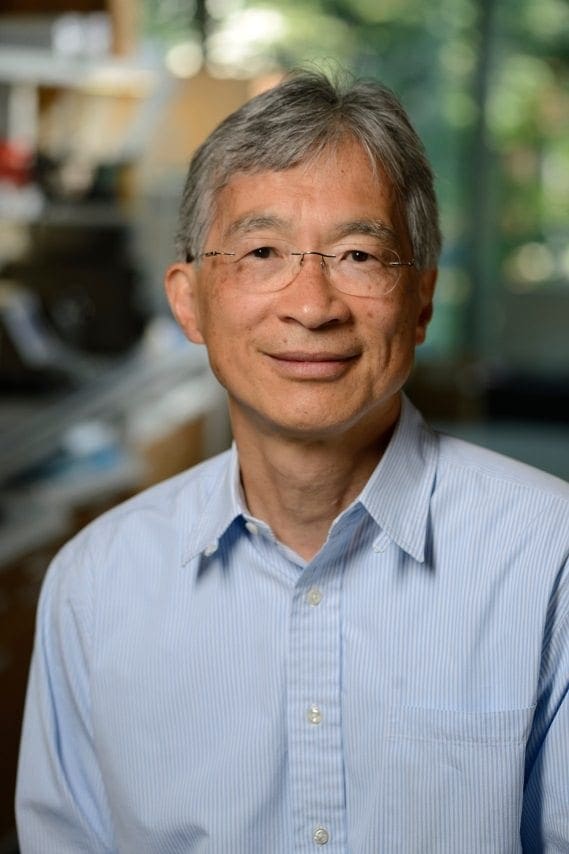
Carl Wu
Bloomberg Distinguished Professor
Contact Information
- [email protected]
- 387 UTL
- 410-516-7496
Research Interests: Chromatin accessibility, nucleosome remodeling and the regulation of gene expression
Education: PhD, Harvard University
Carl Wu joined Johns Hopkins University in 2016 as Bloomberg Distinguished Professor with appointments in the Department of Biology, and the Department of Molecular Biology and Genetics. He received his Ph.D. in Biology at Harvard University and did post-doctoral work as a Harvard Junior Fellow. He was a Principal Investigator at the National Cancer Institute for 30 years, and a member of the Transcription Imaging Consortium at HHMI-Janelia (2012 - 2016). He is a member of the US National Academy of Sciences, National Academy of Medicine, American Academy of Arts and Sciences, Academia Sinica, and the European Molecular Biology Organization.
Carl Wu Laboratory
We study how eukaryotic genes and genomes, organized as nucleosome arrays folded along the length of chromosomes, are regulated by ATP-driven nucleosome remodeling enzymes that shape the epigenomic landscape for transcription.
Research
Eukaryotic genomes are packaged in chromatin as folded arrays of nucleosomes, the fundamental units of histone protein-DNA particles obstructing access to DNA sequence information. To unpack and transform nucleosome structure for gene expression, cells deploy a conserved family of ATP-dependent chromatin remodeling enzymes (CRs), that can be recruited by sequence-specific transcription factors (TFs) to prime or ‘pioneer’ chromatin architecture over regulatory DNAs. Such priming of chromatin—the formation and maintenance of nucleosome-free DNA next to a precisely positioned, biochemically modified, ‘H2A.Z’ variant nucleosome—creates a distinctive gateway adorned with structural and biochemical signals for regulated assembly and function of the RNA polymerase II transcription machinery.
We study the single-molecule biochemistry of priming TFs and CRs in the yeast and fruitfly model organisms, using super-resolution fluorescence microscopy to measure the diffusive trajectories of individual proteins in the nucleoplasm and on chromatin of living cells. We derive the spatiotemporal dynamics of TFs and CRs to reveal how they navigate the nuclear environment to reach functional promoter and enhancer targets. For deeper insights into chromatin remodeling mechanisms, we apply single-molecule TIRF microscopy visualizing protein dynamics on immobilized chromatin templates in vitro, allowing definition of transient reaction intermediates and order of binding events. Of long-standing interest are TFs that bind with high macroscopic occupancy for CR recruitment despite on-off dynamics, as exemplified by the GAGA TF and the NURF CR. We also use cryo-electron microscopy to reveal high-resolution macromolecular structures and conformational transitions of CRs in remodeling pathways. Because many TFs and CRs are causally linked to human disorders and diseases, we are beginning studies on the transcriptional regulation of biomedically significant genes, with the aim of discovering small molecules that restore equilibrium to a dysfunctional epigenomic landscape.
Publications
2026
Ling H, et al. Live-cell single-molecule dynamics of eukaryotic RNA polymerase machineries. Science February 5, (2026).
2025
Ranjan A, et al. Histone acetylation readers Bdf1 and Yaf9 guide targeting of SWR1 remodeler to +1 nucleosome. Science Adv. DOI: 10.1126/sciadv.adt2002 (2025).
Feng XA, et al. GAGA zinc finger transcription factor searches chromatin by 1D-3D facilitated diffusion. NSMB https://doi.org/10.1038/s41594-025-01643-0 (2025).
2024
Louder RK, et al. Molecular basis of global promoter sensing and nucleosome capture by the SWR1 chromatin remodeler. Cell 187(24):6849-64. PMID: 39357520 PMCID PMC11606799 (2024).
Ling YH, et al. Disordered C-terminal domain drives spatiotemporal confinement of RNAPII to enhance search for chromatin targets. Nat Cell Biol. PMID: 38548891, PMCID: PMC11210292 (2024).
Kim JM, Carcamo CC, et al. Dynamic 1D search and processive nucleosome translocations by RSC and ISW2 chromatin remodelers. Elife. 12:RP91433. PMID: 38497611 PMCID: PMC10948146 (2024).
2023
Li X, Tang X, et al. GAGA-associated factor fosters loop formation in the Drosophila genome. Mol Cell. S1097-2765(23)00168-5. PMID: 37003261 PMCID: PMC10396332 (2023).
2022 Carcamo CC, et al. ATP binding facilitates target search of SWR1 chromatin remodeler by promoting one-dimensional diffusion on DNA. Elife. PMID: 35876491 PMCID: PMC9365391 (2022).
Poyton MF, Feng XA et al. Coordinated DNA and Histone Dynamics Drive Accurate Histone H2A.Z Exchange. Science Advances 8 (10). PMID 35263135; PMCID: PMC8906749 (2022).
Tang X, et al. Kinetic Principles Underlying Pioneer Function of GAGA Transcription Factor in Live Cells. Nat Struct Mol Biol, 29: 665-676 PMID: 35835866 PMCID: PMC10177624 (2022).
2021
Nguyen VQ, et al. Spatiotemporal coordination of transcription preinitiation complex assembly in live cells. Mol Cell. 2021 Aug 2:S1097-2765(21)00591-8. doi: 10.1016/j.molcel.2021.07.022. PMID: 34375585 (2021).
Lionnet T, Wu C. Single-molecule tracking of transcription protein dynamics in living cells: seeing is believing, but what are we seeing? Curr. Opin. Genet. Devel.: Volume 67, April 2021, Pages 94-102 https://doi.org/10.1016/j.gde.2020.12.001 (2021).
Kim JM, et al. Single-molecule imaging of chromatin remodelers reveals role of ATPase in promoting fast kinetics of target search and dissociation from chromatin. Elife. 2021 Jul 27;10:e69387. doi: 10.7554/eLife.69387. PMID: 34313223 (2021).
2020
Ranjan A, et al. Live-cell single particle imaging reveals the role of RNA polymerase II in histone H2A.Z eviction. eLife 2020;9:e55667 DOI: 10.7554/eLife.55667 (2020).
Personnel
Robert Louder, Assistant Research Professor
Anand Ranjan, Staff Scientist
Xiaona Tang, Staff Scientist
Giho Park, MD-PhD student
Zelin Wei, PhD student
Maryam Yamadi, PhD student
Alice Chen, PhD student
Fijare Plous, PhD student
Oluwakemi Abiodun, MS student
Kayra Ozturan, MS student
Sophie Yao, Research Technologist